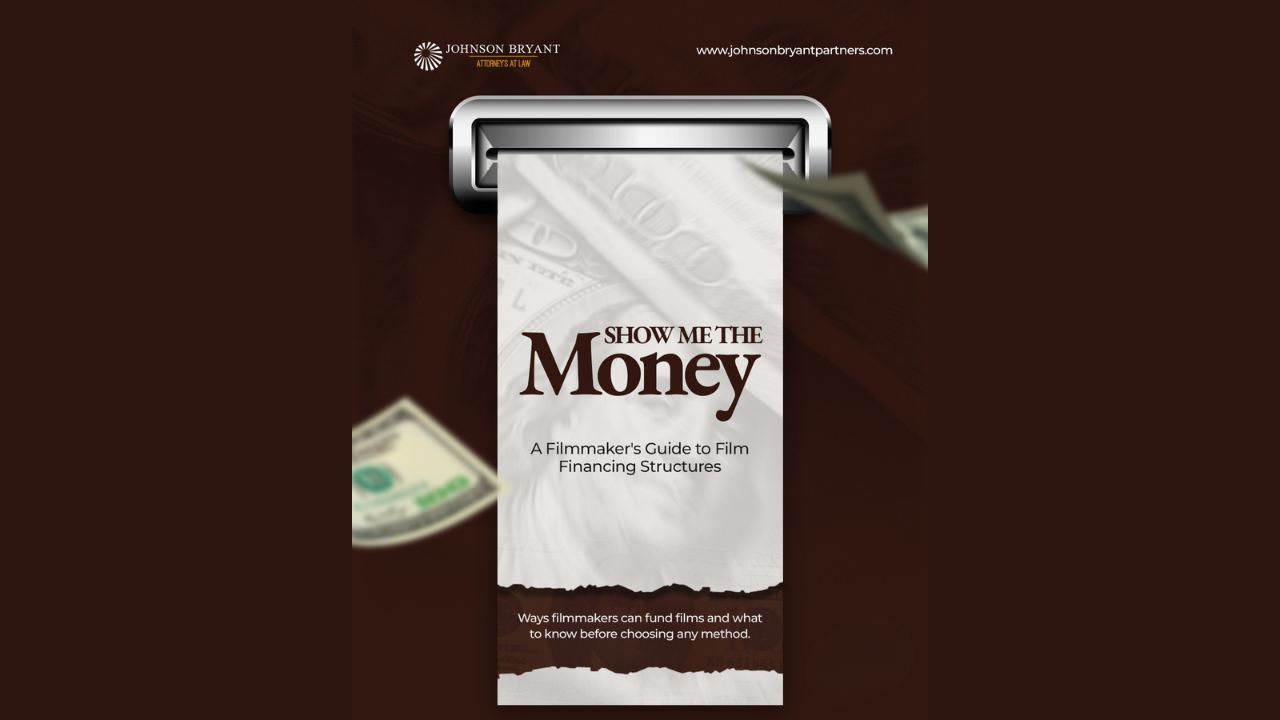
Show Me the Money: A Filmmaker's Guide to Film Financing Structures
When the credits roll and the lights come up, the conversation usually turns to the performances, the cinematography, and the story. Rarely do we pause to ask: how did this film even get made? Behind every great production is a financial architecture as intricate as the screenplay itself. Films consist of a carefully assembled structure of deals, risks, and legal commitments that make it possible to turn a script into a motion picture.
Film financing is hardly done by a single transaction. It is a landscape of different methods, each with its own logic, appeal, and trade-offs. Here is a breakdown of the eight main ways films are financed and what every filmmaker should know before committing to any of them.
1. Equity Financing: Selling a Share of the Film
An investor puts money into the film in exchange for a percentage of the profits. They become part-owners of the project with no repayments, no interest, and no collateral required. If the film earns, they earn. If it does not, they absorb the loss alongside the producer.
The catch is that films can take years before returns materialise. A well-drafted investor agreement must define exactly what percentage of profits is being shared, from which revenue streams, and in what order. Without that precision, disputes are almost inevitable.
2. Debt Financing: Borrowing Against the Film's Future
The filmmaker takes a loan and repays it with interest, regardless of how the film performs. In some markets, banks lend against pre-sale contracts or tax credits rather than physical assets. In Nigeria, traditional commercial banks remain risk-averse due to the perceived volatility of films, however some financial firms such as Chapel Hill Denham and MBO Capital are towing a path that includes debt financing amongst other financing methods. Producers who access debt financing must be rigorous about repayment timelines. A loan that makes sense in pre-production can become a crisis mid-shoot if the budget runs over.
3. Pre-Sales: Getting Paid Before the Film Is Finished
Here, a distributor agrees to pay a set fee for the rights to distribute the film in a specific territory before production is complete. The filmmaker can then use that contract to unlock financing by borrowing against it or to cover production costs immediately. Pre-sales reduce risk for everyone: the filmmaker gets early capital, and the distributor secures content ahead of competition.
A pre-sale is only as valuable as the contract behind it. To be bankable, it must be legally enforceable, and that requires clean chain-of-title documentation and, typically, an Errors and Omissions (E&O) insurance policy. Producers who skip these steps often discover their pre-sale contracts are worth far less than anticipated.
4. Co-Productions: Sharing the Budget Across Borders
Two or more production entities (sometimes from different countries) formally partner to make a film, with each contributing money, talent, or facilities. The film qualifies as a domestic production in both countries, unlocking government funding and tax incentives across multiple jurisdictions simultaneously.
Co-productions are legally complex. Creative control, profit-sharing, and intellectual property ownership all require meticulous documentation. A vaguely drafted co-production agreement can lead to an expensive dispute.
5. Streaming Platform Commissions: The New Studio Model
Platforms like Netflix and Prime Video commission original content directly, paying a production budget in exchange for global streaming rights, or ownership in some cases. This model has been transformative for Nollywood, providing reliable upfront capital without the uncertainty of box office performance.
The trade-off is ownership. Most commission deals see the platform acquire exclusive global rights, often for a very long period. Understanding exactly what rights are being transferred and under what conditions is the most critical legal question in any streaming deal.
6. Government/Donor Grants and Public Funds: Capital Without Repayment
Several governments and donor organisations operate film funds that inject non-repayable capital into qualifying productions. South Africa's NFVF and Africa No Filter, are among the most active on the continent. Grants carry no ownership dilution and no repayment pressure.
They do carry conditions: eligibility criteria, local content requirements, reporting obligations, and audit processes. Public film funding also cannot be arbitrarily withdrawn mid-production without proper legal process. It is important to know what you are agreeing to before you accept the money.
7. Brand Sponsorship and Product Placement: Commercial Partnerships on Screen
A brand contributes money, goods, or services in exchange for visibility through product placement, logo credits, or a marketing campaign around the release. Widely used in Ghanaian cinema and growing in Nollywood, this model can close a meaningful funding gap without giving up equity.
The risk is creative independence. A sponsor with significant financial skin in the game may begin influencing creative decisions. A clear sponsorship agreement must preserve the filmmaker's creative control from the outset.
8. Private Investment from High-Net-Worth Individuals: Passion Capital
A successful entrepreneur, a diaspora professional, or a wealthy film enthusiast invests in a production for a combination of returns, social capital, and the genuine excitement of being associated with a cultural product. This model has quietly financed much of Nollywood's recent premium growth, offering speed and directness without institutional gatekeeping.
Speed is not a substitute for documentation. Even where the investor is a personal contact, the legal paperwork must be formal: amount invested, return structure, distribution timeline, and what happens if the film underperforms. Poorly documented private investments are a common source of film financing disputes in Nigeria.
Final Thought
Whatever structure you choose, the most important investment you can make is getting the legal architecture right before production begins. Every financing route described above has worked for films made on the continent. The difference between a smooth production and a costly dispute usually comes down to how carefully the deal was documented.
If you are raising money for a film or series and want to understand which structure makes sense for your project, reach out to us at Johnson Bryant Partners.