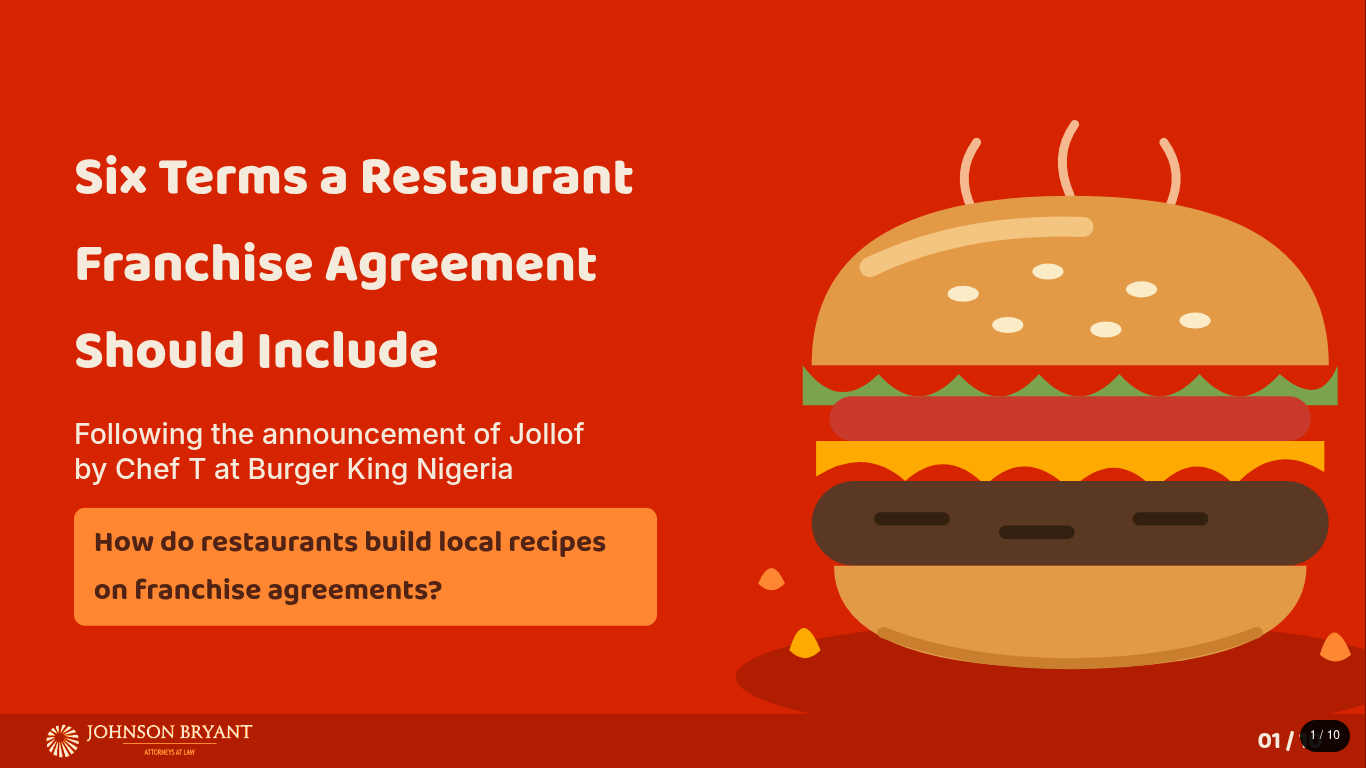
A franchise agreement in Nigeria has to answer a practical question early in the relationship, which is what happens when the franchisee wants to change the menu. The answer draws on trademarks, recipes, royalties, tax and exit, and a contract that is silent on any one of them can leave the franchisee, the brand owner and any chef involved with competing claims.
Burger King Nigeria's recently announced Jollof by Chef T, a partnership with chef Tolani Tayo-Osikoya that places a Nigerian chef's name on a Nigerian staple inside a global burger brand, is a useful illustration of why. We have not seen any of the agreements behind it, and nothing in this article describes them, but a local dish with a named chef attached raises the questions any restaurant franchise agreement needs to settle, and the six terms below follow those questions in the order they tend to arise.
Is there a franchise law in Nigeria?
Nigeria has no franchise-specific statute. The Franchising (Establishment) Bill passed the Senate in January 2023 and is reported to be awaiting presidential assent; until it becomes law, a franchise runs under its contract, guided by the general law of the country. In practice, that general law comes from five places:
- The National Office for Technology Acquisition and Promotion (NOTAP) Act, which requires registration of agreements for the transfer of foreign technology and is treated as covering franchise agreements;
- The Trade Marks Act 1967, as amended by the Business Facilitation (Miscellaneous Provisions) Act 2022, which governs the brand and dish names;
- The Copyright Act 2022, which covers campaign content and the written and filmed side of recipes;
- The Federal Competition and Consumer Protection Act 2018 (FCCPA), which reaches exclusive dealing, supply tie-ins and resale prices; and
- The Nigeria Tax Act 2025 together with the withholding tax regulations, which govern royalties and fees.
There is also no mandatory disclosure document and no cooling-off period, which leaves a prospective franchisee to carry out its own due diligence on the franchisor and to get every commitment into the agreement itself. That places considerable weight on drafting, and it is why the rest of this article concentrates on what the contract should say.
Does a franchise agreement in Nigeria need NOTAP registration?
Where a Nigerian operator pays royalties to a foreign brand owner, NOTAP treats the franchise agreement as a technology transfer agreement, and the NOTAP certificate is what the banks look for before they remit those royalties abroad. The Court of Appeal has held that failing to register such an agreement does not make it invalid or unenforceable, so the consequence of non-registration is commercial. The royalty may not be remittable through the banking system, which matters a great deal to a foreign brand owner expecting to be paid.
NOTAP lists "Hotels and Restaurant" and "Franchising" among the sectors in which it registers agreements, although its franchise guidance names departmental stores, manufacturing and hotels as the examples where a franchise agreement can be approved. How NOTAP will treat a particular restaurant agreement is therefore worth confirming before a royalty is agreed, and an agreement between two Nigerian parties, which involves no transfer of foreign technology, generally falls outside the Act.
Term 1: Menu approval in a franchise agreement
A franchise licenses a brand owner's trademarks and know-how, and the menu is where both reach the customer, which is why brand owners control it through brand standards written into the agreement or into an operations manual that the agreement incorporates. Nigerian law sets no menu approval process, so the contract has to supply one, and a franchisee who wants to add a local dish needs to know how to go about it per such contract.
A workable clause identifies who may propose a local item and what the proposal must contain, such as the recipe, the costing, the intended supplier and the results of any testing. It sets out the approval steps and the timelines, including what happens where the brand owner does not respond, and it states the standard upon which approval can be refused, since approval that may not be unreasonably withheld gives a franchisee something it can enforce. It should also say whether an approved item can be used elsewhere in the brand's system and, if it can, whether the franchisee is paid or credited for having developed it, because that question decides who benefits when a local dish succeeds.
Term 2: Intellectual property ownership in a franchise agreement
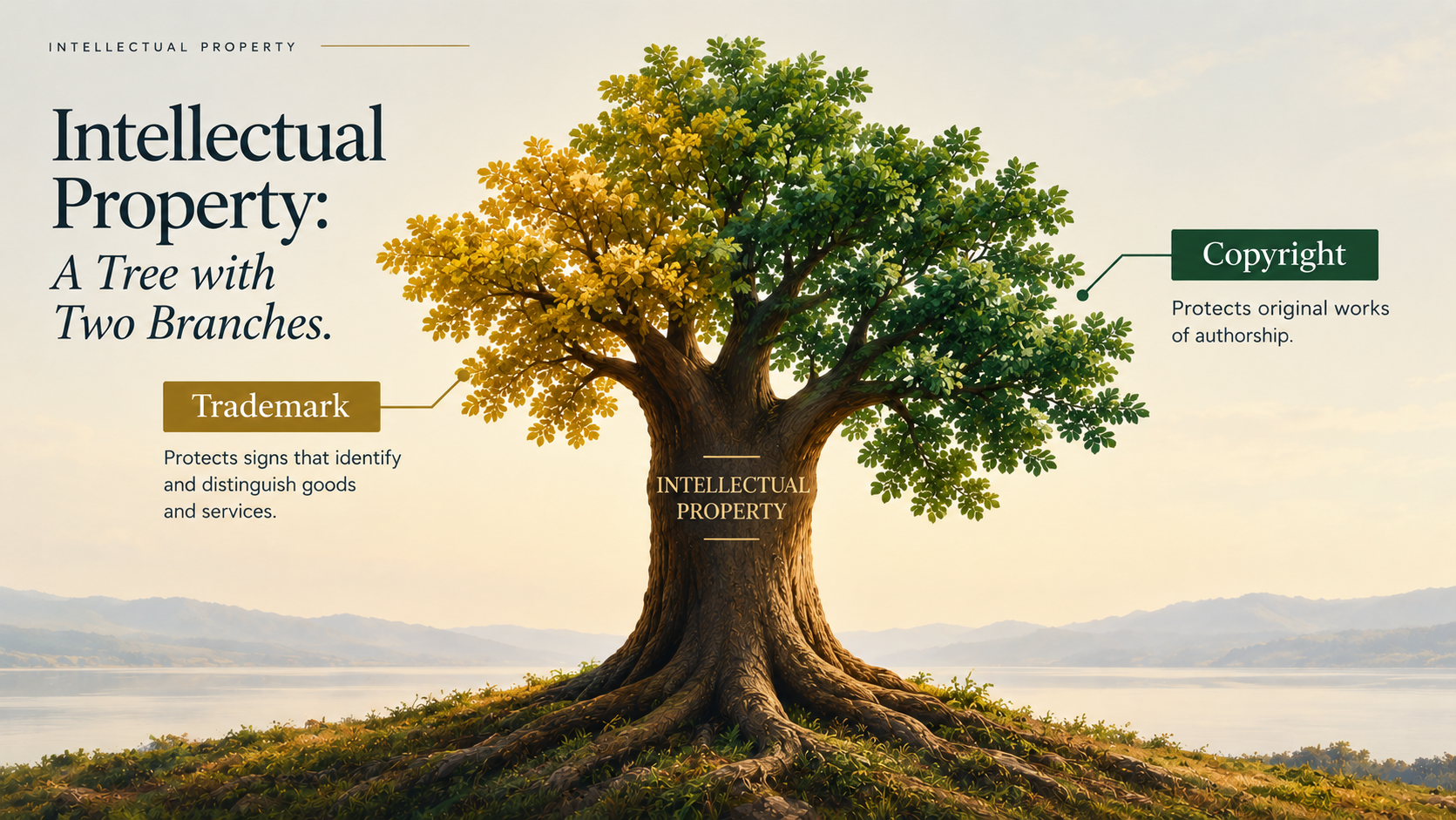
Once a dish is approved, the next question is who owns what it produces, and the answer differs for each of the three assets a new dish creates: the recipe, the name and the marketing content.
The Copyright Act 2022 excludes ideas, procedures, processes and methods from copyright (section 3(a)), so the method of making a dish sits outside it, while the written text of a recipe and photographs or video of the dish can qualify if they are original and fixed in a medium (section 2(2)). Protection for the recipe itself therefore rests mainly on confidentiality and the contract, which puts confidentiality clauses, access controls and post-termination obligations at the centre of any agreement involving a locally developed recipe.
A dish name is a candidate for trade mark protection, and under the Trade Marks Act only a registered mark can found an infringement action, leaving the owner of an unregistered mark with a claim in passing off (section 3). Registration is made in respect of particular goods (section 4), and the 2022 amendment to section 67 extended the definition of goods to include services. Nigeria is often described as a first-to-file jurisdiction, but the Act is more nuanced, because a person who has used a mark continuously from before the proprietor's use or registration can keep using it (section 7). Early registration and clear ownership from the outset are therefore the safer course, and an assignment of a registered mark should be recorded, since a document that has not been entered on the register cannot be admitted in evidence to prove title unless the court directs otherwise (section 30(3)).
Marketing content raises a separate question. Copyright vests first in the author except as an agreement provides (section 28(1)), and the default rule for commissioned work in section 28(3) covers private and domestic commissions only, so for a commercial shoot the starting point is that the author owns the copyright unless the agreement says otherwise. An assignment or exclusive licence has no effect unless it is in writing (section 30(3)), and authors keep moral rights of attribution and integrity that cannot be transmitted during their lifetime (section 14(3)), which means the contract should deal with credit and edits directly.
Taken together, the agreement should settle who owns locally developed recipes and dish names and who applies to register the names in Nigeria, whether the brand owner receives a licence back and on what terms and for what payment, how recipes are kept confidential during and after the term, and how photographs, video and campaign content are assigned or licensed in writing.
Term 3: Chef and creator partnerships and image rights
Where a dish carries a chef's name, a third party enters the picture, and the franchise agreement has to say when the brand owner must consent to that partnership and what it controls, while the chef's own contract has to say what she licenses. Nigeria has no dedicated statute on image rights, so a chef's name and likeness are protected through the constitutional right to privacy (section 37 of the 1999 Constitution), passing off, IP statutes where a name is registered, and above all contract, which means the chef's licence carries most of the weight.
Where the chef's name becomes a mark, as with a dish sold under her name, the Trademarks Act offers a useful mechanism. A person other than the proprietor can be registered as a registered user (section 33), on an application that needs a statutory declaration describing the relationship and the degree of control the proprietor holds over the permitted use (section 34(1)). Use by a registered user counts as use by the proprietor (section 33(3)), which helps protect the mark against removal for non-use (section 31), although the Registrar must refuse an application that would facilitate trafficking in a mark (section 34(3)).
The agreements should therefore deal with whether co-branding with the brand owner's marks is allowed, who consents to it and who approves artwork; who signs for the chef and, where it is her company, whether that company holds the rights it purports to license; the scope of the licence in terms of name, image, voice and recipe, products, channels, territory and term; and exclusivity, approval rights over marketing and reputation clauses.
Term 4: Franchise fees, royalties and withholding tax in Nigeria
A new dish also raises the question of who pays whom, and here three payments can attach to one product, each sitting in a different agreement and following different rules.
The first is the royalty to a foreign brand owner, which falls within the NOTAP regime. The NOTAP Act requires registration of agreements between a person in Nigeria and a person outside Nigeria for the use of trademarks and similar rights within 60 days of execution (section 5(2)), and NOTAP's published requirements list the approvable franchise fees as a reasonably fixed initial fee, a continuing fee of 0.5% to 2% of net sales or revenue, and a marketing fee of 1% of net sales or revenue. Fees above those ranges risk not being cleared for remittance, and NOTAP will not register an agreement that contains a resale price provision.
The second is the tax on that royalty. The Deduction of Tax at Source (Withholding) Regulations 2024 set royalties at 10% for companies and 5% for individuals, according to practitioner summaries, and tax deducted on a payment to a non-resident is generally final tax. The Nigeria Tax Act 2025, in force from 1 January 2026, defines royalty to include payments for the right to use intellectual property, so non-resident licensors should expect withholding tax unless a treaty gives relief, and the agreement should say whether royalties are stated gross or net of tax and who bears the deduction. The third payment, the fee to the chef or her company, is a local payment with its own tax treatment, and both warrant advice from a tax adviser.
Two further points sit alongside the money. A royalty in dollars against sales in naira creates exchange rate exposure, so the agreement should state the currency of payment and who bears the movement. On pricing, the FCCPA prohibits minimum resale price maintenance (section 63), so a brand owner may recommend a price, while a clause requiring the operator to charge no less than a set figure falls within the prohibition. The fees clause should therefore say whether local items carry the royalty and the marketing fee and on what base, who bears the chef's fee and how it is calculated, and who sets prices within the FCCPA limits.
Term 5: Supplier, ingredient and food safety standards
A new dish brings new ingredients, and jollof, which needs rice and a tomato and pepper base that a franchisee will want to source locally, shows why the agreement has to say who sets the specification and who carries the risk if something goes wrong. Food businesses fall within NAFDAC's food hygiene rules, which apply to establishments that prepare, handle or sell food, and under the FCCPA the FCCPC can require the recall of goods it believes to be unsafe. NOTAP's approach also emphasises local content, so a local supply chain can support registration as well as reduce cost.
Supply rules engage competition law as well. A clause requiring the operator to buy only from designated suppliers is tested under the FCCPA provisions on restrictive agreements and exclusionary provisions (sections 59 and 61), and while a brand owner is entitled to set specifications, a tie-in that goes further needs a justification and, in some cases, authorisation under the FCCPC's Restrictive Agreements and Trade Practices Regulations 2022. A sound standards clause therefore lists approved suppliers and ingredient specifications with a fair process for adding local suppliers, allocates responsibility for food safety, labelling and recalls including who pays, gives the brand owner audit and inspection rights on reasonable notice and subject to confidentiality, and deals with insurance and indemnities for product liability.
Term 6: Termination and exit in a restaurant franchise agreement
Franchises end, and so do chef partnerships, so the last term is the one that determines whether the earlier ones survive a break-up. If the chef's licence outlasts the franchise, the operator may owe a chef for rights it can no longer use, and if it ends first the operator may be left with a dish it cannot name, which is why the two agreements should be drafted to end in step.
The IP mechanics matter at this stage. A registered user entry can be cancelled on the application of the proprietor or the registered user (section 34(5) of the Trade Marks Act) and any assignment should be recorded, while copyright licences end on their own terms and an assignment or exclusive licence works only if it is in writing (section 30(3) of the Copyright Act). Post-termination restrictions need care as well, because a clause stopping a former franchisee from operating a competing restaurant is tested against the common law rule on restraint of trade and the FCCPA and should be kept narrow in time, place and scope. Practitioner commentary also reports that NOTAP prefers Nigerian governing law and may reject agreements that submit the franchisee to a foreign jurisdiction, and while the Copyright Act allows disputes under it to go to arbitration (section 37(7)), the Arbitration and Mediation Act 2023 governs arbitration more generally.
In practice, an exit clause should provide for delisting rights and a sell-off period for stock and packaging, stop-use of the chef's name, image and existing content including online, the ownership of locally developed recipes and names after exit and the confidentiality that survives it, cancellation of registered user entries and recordal of any assignment, and the governing law and dispute resolution that will apply.
Franchise agreement checklist for Nigerian restaurants
Read together, the six terms form a checklist that a franchisor or franchisee can run against any draft. The menu approval process, timelines and refusal standard should be written down; ownership of local recipes, dish names and content should be settled, with names registered in Nigeria; chef and creator deals should be licensed in writing, with co-branding consent covered; NOTAP registration should be assessed for any agreement with a foreign brand owner; royalties should be modelled gross and net of withholding tax with the currency stated; pricing, territory and supply clauses should be tested against the FCCPA; supplier specifications, food safety and recall responsibility should be allocated; and the exit terms should line up across the franchise agreement and every partnership.
Frequently asked questions
Is there a franchise law in Nigeria?
Nigeria has no franchise-specific statute, so franchises are governed by the franchise agreement together with general law, including the NOTAP Act, the Trade Marks Act, the Copyright Act 2022, the FCCPA and tax legislation. The Franchising (Establishment) Bill passed the Senate in January 2023 and is reported to be awaiting presidential assent.
Does a franchise agreement have to be registered with NOTAP?
Where a Nigerian franchisee contracts with a foreign franchisor, NOTAP treats the agreement as a technology transfer agreement to be registered, and the certificate is what banks look for before remitting royalties abroad. Because the NOTAP Act is aimed at the transfer of foreign technology, an agreement between two Nigerian parties generally falls outside it, although the position turns on the facts and is worth confirming.
Is an unregistered franchise agreement enforceable in Nigeria?
The Court of Appeal has held that failing to register a technology transfer agreement under the NOTAP Act does not make it invalid or unenforceable. The practical risk lies elsewhere, because royalties cannot be remitted through the banks without the certificate and late registration can attract penalties.
Can a franchisee add its own menu items in Nigeria?
A franchisee can add its own menu items only to the extent the franchise agreement permits it. Nigerian law sets no menu approval process, so the contract should state who may propose local items, how approval works and how long it takes, and a franchisee should have that in writing before it launches a local dish.
Who owns a recipe developed by a franchisee?
The agreement decides, because Nigerian law gives limited default protection. The Copyright Act 2022 excludes methods and processes from copyright, so the method of a recipe is protected mainly by confidentiality and contract, while dish names can be registered as trade marks and photographs and videos are protected by copyright, which vests first in the author unless an agreement says otherwise.
Can a franchisor fix resale prices in Nigeria?
A franchisor cannot require a minimum resale price, since the FCCPA prohibits minimum resale price maintenance (section 63) and NOTAP will not register an agreement that contains a resale price provision. A franchisor may recommend prices.
What tax applies to franchise royalties paid to a foreign franchisor?
Non-resident licensors should expect withholding tax on royalties unless a tax treaty gives relief, and practitioner summaries put the rate under the 2024 withholding regulations at 10% for companies. Current rates and gross-up terms should be confirmed with a tax adviser before an agreement is signed.