On August 25, 2026, the estate of Dolly Parton confirmed her death on her social media page. Parton, who died at 80, grew up in a large musical family in rural Appalachia and started performing as a child, singing on local East Tennessee radio and television before her Grand Ole Opry debut at 13, the same year she recorded "Puppy Love" for Goldband Records.
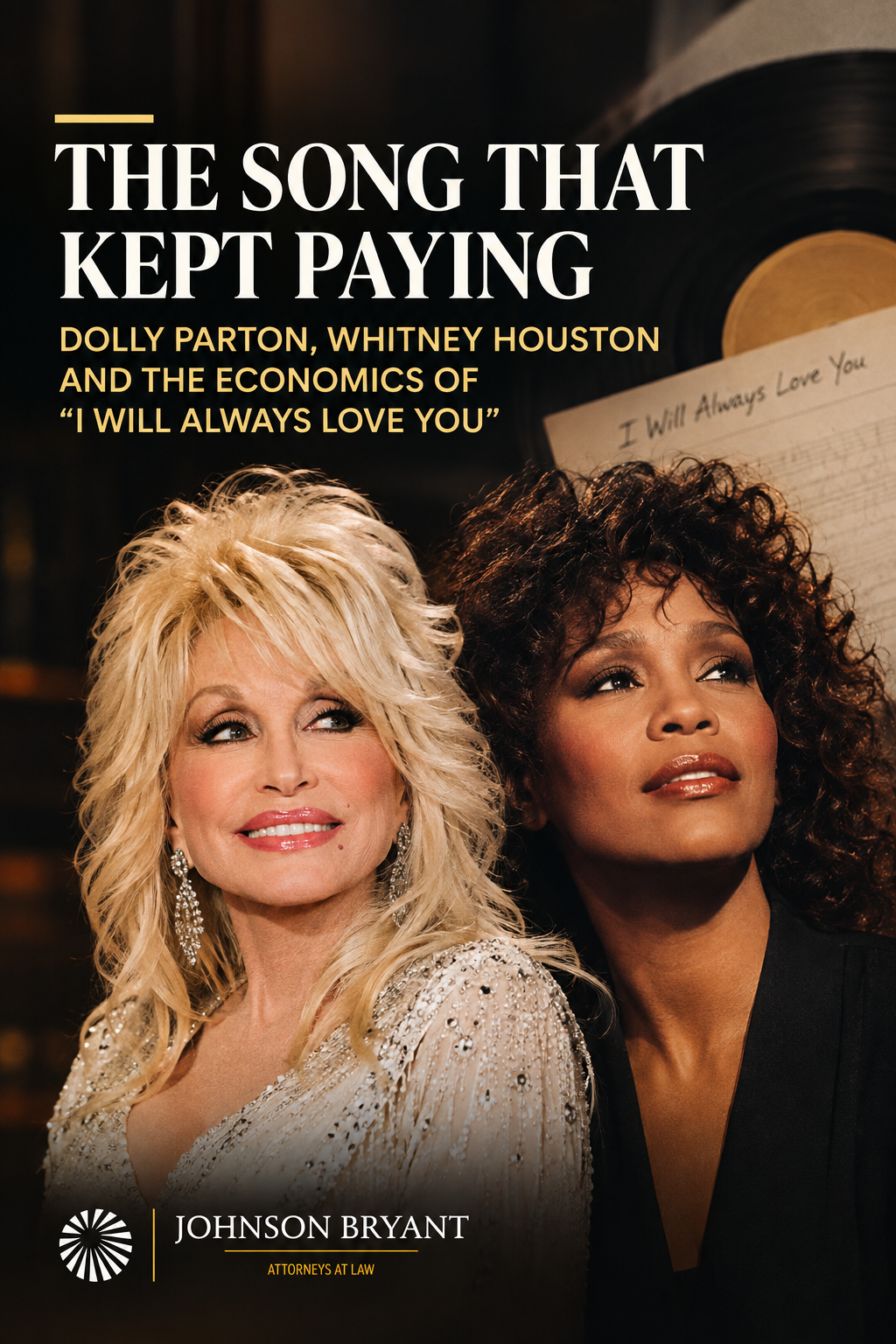
Her earliest success came as a songwriter. After signing with Combine Publishing in Nashville, she wrote charting singles for other artists. But no songwriting story of hers compares to "I Will Always Love You," which she recorded in March 1974 and which Whitney Houston covered on November 3, 1992.
That song's journey is a case study in the difference between owning a sound recording and owning a musical composition. A composition is the underlying work, the lyrics and melody. A sound recording is one particular performance of it. As the songwriter, Parton held the rights to reproduce, perform, adapt, and license the composition, and to collect royalties across all of it. Houston's recording was a separate copyright, with its own revenue from reproduction, distribution, and streaming. That split decided who controlled each use of the work and who got paid for it.
Parton wrote the song in 1973 while preparing to leave Porter Wagoner's television show and go solo. It was a farewell to Wagoner, grateful but firm about her decision to move on. Released in 1974, it hit No. 1 on the Billboard Hot Country Songs chart, and her 1982 re-recording for The Best Little Whorehouse in Texas did the same. By the time Houston recorded it, the song already had a proven commercial track record.
One near-miss is worth noting. According to the U.S. Copyright Office's account, Elvis Presley wanted to record the song, but his management reportedly asked for half the publishing as a condition. Parton turned the deal down. By keeping her publishing intact, she preserved her stake in whatever came next, including Houston's version years later.
Houston recorded her version for The Bodyguard, the 1992 film in which she starred opposite Kevin Costner. With David Foster producing, Houston pushed the song into pop and R&B territory while keeping its emotional core. The sync placement in a hit film gave it a far wider audience than the country charts alone, and the strategy paid off: the soundtrack reportedly sold more than 45 million copies worldwide, and Houston's single spent 14 weeks at No. 1 on the Billboard Hot 100.
Money from Houston's specific recording went to the owners tied to that master. But because the recording still embodied Parton's composition, its commercial use also generated mechanical royalties from reproduction, performance royalties when played publicly, and sync income wherever it was licensed for film or TV. Parton's payday came from holding the rights to the song itself, not from owning Houston's master.
Parton's death doesn't end the song's commercial life. Copyright is a form of property, and the economic rights tied to a song generally outlive its creator, becoming part of the estate, subject to how the rights were structured and whatever arrangements Parton made while alive. Royalties can keep flowing for decades after the person who wrote the song is gone, just to whoever now holds the rights.
What this shows for anyone managing music rights:
1. Retaining publishing builds long-term value. Parton chose an ongoing interest in the composition over a one-time payout from Elvis, and that choice paid off decades later.
2. Know exactly what you own. Parton held the composition; Houston's recording was a separate asset with its own rights and its own revenue stream.
3. A song can have several commercial lives, earning again through new recordings, films, performances, streaming, and licensing.
4. Catalog value can grow over time as older work gets rediscovered, re-recorded, or reaches a new audience.
5. Copyright can outlive a career and a life, which is the clearest argument for treating publishing rights as a long-term asset rather than income for an active career only.